
Kansas

Wyandotte County faces a crowded incentive landscape as Chiefs stadium talks intensify

Kansas politics and local development buzz have converged in an unprecedented way: the Kansas City Chiefs’ potential move across state lines has turned Wyandotte County and neighboring cities like Olathe into arenas for competing economic incentives. What began as a singular bid for an NFL stadium has mushroomed into a complex web of STAR bond districts, municipal tax pledges, and fierce negotiations involving key decision-makers and business partners statewide.

At the heart of the effort is a massive plan to build a $3 billion domed stadium in Wyandotte County, paired with a new Chiefs headquarters and training facility in Olathe, Johnson County — a project with total development costs approaching $4 billion. The state of Kansas and the Chiefs organization negotiated a public-private partnership that uses STAR (Sales Tax and Revenue) bonds to finance up to 60 percent of the public portion of the work, with the team covering the remaining share. STAR bonds allow public sales tax generated within a designated district to be used to repay bondholders without creating new tax levies on residents.

In Wyandotte County, the Unified Government (UG) of Wyandotte County and Kansas City, Kansas, has held spirited hearings on an ordinance that would establish a STAR bond district stretching more than 200 acres between 118th and 126th streets. Under the proposal, Wyandotte County would pledge future local sales tax, part of county sales tax, and up to 8 percent of transient guest taxes collected in the district toward bond repayment for up to 30 years. A key figure at recent hearings was Todd LaSala, outside development counsel for the UG, who outlined the financial mechanics and conditions for local participation.

Meanwhile, in Olathe, city leaders have moved aggressively on their piece of the Chiefs puzzle. The Olathe City Council voted unanimously to pledge local sales and hotel tax revenue from a 165-acre development site at College Blvd. and Ridgeview Rd. to support STAR bonds for the Chiefs’ headquarters and practice facility. As part of that plan, Olathe would redirect 1 percent of city sales tax and portions of county and hotel taxes generated in the “base revenue area” toward bond repayment. This commitment stretches up to three decades but avoids raising existing tax rates. Mayor John Bacon and council members championed the measure as a catalyst for jobs and long-term economic growth, even amid vocal public debate.

The Chiefs organization, led by Chairman and CEO Clark Hunt, has signaled strong support for both STAR bond districts, making clear that local incentives were a crucial part of the overall agreement with the state. Gov. Laura Kelly and state legislative leaders also played central roles in crafting the incentive framework, including the use of Kansas’s Attracting Professional Sports to Kansas Fund alongside STAR bonds to sweeten the deal without imposing new statewide taxes.

For Wyandotte County and its neighbors, this isn’t just a stadium bid — it’s a test of economic strategy under pressure. With multiple communities pledging future tax revenues and public hearings drawing packed rooms, the Chiefs project has become a catalyst for reconsidering how incentives are used, who pays the price, and how long the benefits must be weighed against competing development needs. 


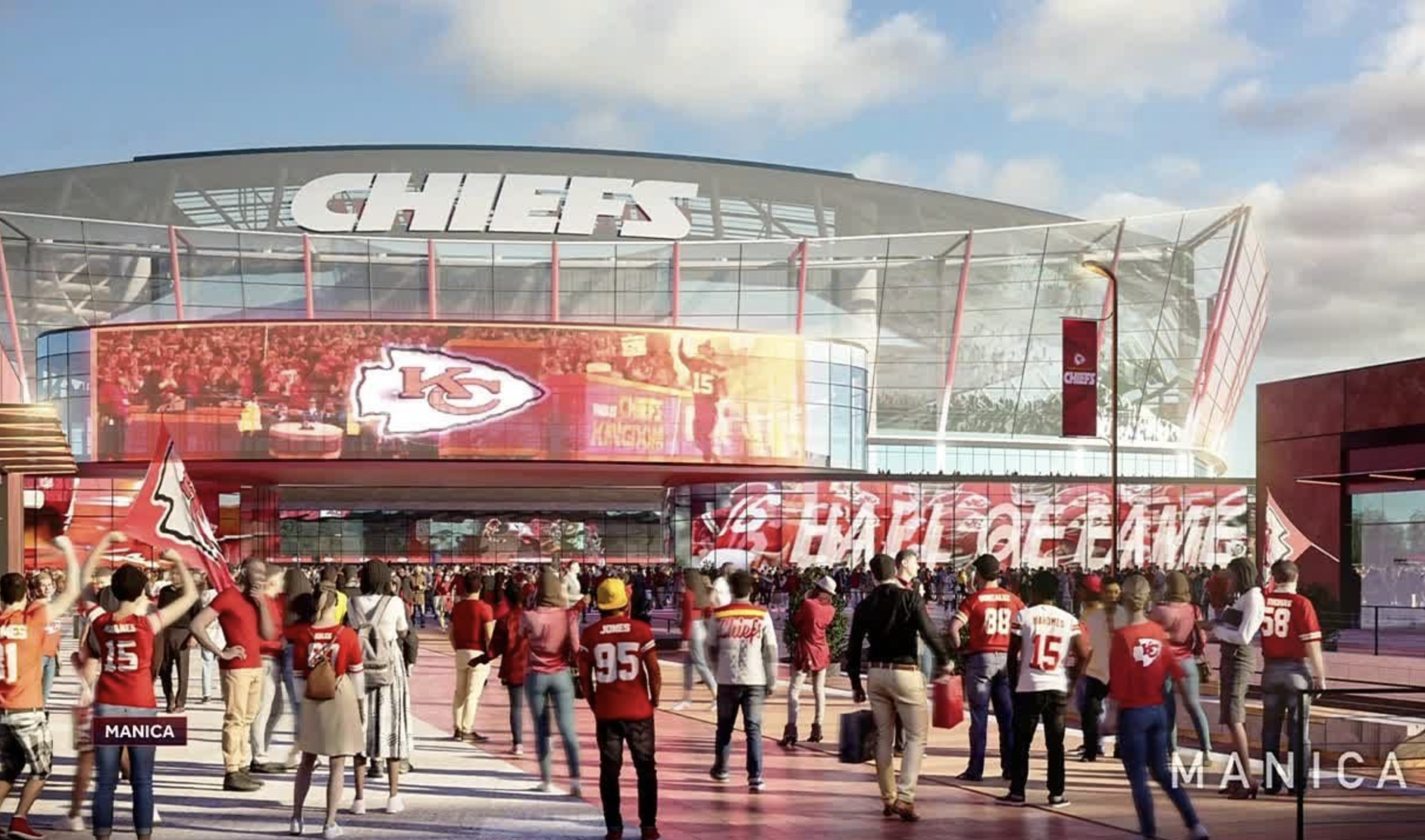
Header image A rendering of a domed Kansas City Chiefs stadium in Wyandotte Co., Kansas. Image | Manica Architecture


Chiefs’ move to Kansas could transform commercial development across the metro

The Kansas City Chiefs’ planned move to the Kansas side of the Kansas City metro area is already reshaping expectations for commercial growth, real estate investment, and long-term economic development. While the relocation would mark the end of the team’s decades-long run in Missouri, it is widely viewed by Kansas officials and developers as a generational opportunity to anchor new construction and private investment around a modern NFL stadium.

The proposed project centers on a new domed stadium in Wyandotte County, a move that would position the region to compete for major events beyond professional football, including concerts, conventions, and national sporting events. Economic development leaders say the stadium itself is only part of the story. The surrounding land is expected to attract a wave of mixed-use development designed to create year-round activity rather than a venue that sits largely idle outside of game days.

Developers are already speculating about new hotels, restaurants, and entertainment concepts aimed at capturing crowds drawn by games and special events. Retail space, office buildings, and residential projects are also likely, following a national trend in which sports venues anchor walkable districts that blend work, housing, and leisure. Similar developments around newer NFL stadiums have shown that teams increasingly serve as catalysts for broader commercial ecosystems rather than standalone attractions.

The Chiefs’ potential relocation is also expected to influence development patterns beyond the stadium site. Areas along major highway corridors in Kansas could see increased interest from employers seeking proximity to a high-profile destination and improved infrastructure. Hospitality and service industries are anticipated to benefit most immediately, while longer-term growth could include corporate offices and regional headquarters drawn by the visibility and prestige associated with the franchise.

Supporters argue the move would solidify the Kansas side of the metro as a hub for sports-driven economic development, while critics raise concerns about public financing and the loss of revenue for Missouri. Even so, real estate professionals note that large-scale stadium projects often generate momentum that extends well beyond initial projections, especially when paired with intentional planning and private-sector participation.

If the relocation proceeds, the Chiefs’ new home could reshape the commercial landscape of the metro area for decades, signaling a shift in how professional sports franchises influence urban growth, land use, and regional competition in the Kansas City area.


Header image: A rendering of a new Kansas City Chiefs stadium that may be built near the Legends in Wyandotte County, Kan. Image | Manica

Children’s Mercy moves forward adding new medical office building to Overland Park campus

City planners have given preliminary approval for Children’s Mercy to add a four-story medical office building and lobby extension to its Overland Park hospital campus, a move officials say will consolidate outpatient services, add parking, and support a wider $152 million expansion of the facility.

The Overland Park Planning Commission this summer unanimously approved a revised development plan and forwarded the proposal, which covers the site near 5808 West 110th St, to the City Council with conditions that address stormwater, signage, mechanical screening, and pedestrian access.

Hospital officials have said the office building is a central element of the system’s multi-phase program to modernize the Kansas campus, consolidate outpatient clinics now scattered across multiple locations and free up space inside the hospital for renovated inpatient and procedural services. The health system announced the broader $152 million project in April, describing the medical office building as part of work that also includes surgical upgrades, new service offerings and exterior and parking improvements.

Children’s Mercy’s public materials and local news reports say the new outpatient facility is intended to create a more seamless experience for patients and families and to concentrate specialty clinics and administrative offices that currently occupy a variety of sites. Project schedules published by the hospital indicate the medical office building is slated to open in the summer of 2027, with other campus renovations rolling into 2029.

The planning documents submitted to the city include site maps, stormwater studies and design standards that will guide the next stage of approvals; they require the hospital to resolve engineering and landscaping details before a building permit is issued. Those conditions are typical for campus expansions that abut established neighborhoods and major arterials, city staff wrote in a companion report.

If the City Council approves the plan, the project will move into final development review and permitting. Hospital leaders have framed the work as an investment in regional pediatric capacity, saying improvements at Overland Park will benefit families across Kansas while complementing Children’s Mercy’s larger system campuses. 


Header image: A rendering of the preliminarily approved new four-story medical office and lobby extension of Children's MercyOverland Park, Kan. Image | Children's Mercy credit: HDR

DBIA-MAR gala celebrates design-build Excellence Awards

DBIA-MAR gala celebrates design-build Excellence Awards

Feature photo credit: Arch Photo KC

Pretzels plans to expand manufacturing facility

Pretzels plans to expand manufacturing facility

Image courtesy of KCADC