Industrial

Kansas City Industrial Growth: Smarter Sites, Stronger Collaboration

MetroWire Media closed out its 2025 programming with a standout KC MWM Industrial Summit, hosted at Johnson County Community College. With rising construction costs, evolving tenant expectations, and major infrastructure needs, our expert panel explored what’s driving Kansas City’s industrial momentum—and how the region is positioning for what’s next.

Special thanks to our sponsors who made this event possible:

Platinum Sponsors: JE Dunn Construction, Miller Stauch Construction
Bronze Sponsors: Bartlett & West, ARCO, Seal-O-Matic, Armstrong
Brew Crew Sponsors: Capitol Federal, KC SmartPort, BHC, studioNorth Architecture

What Makes KC Competitive?

Chris Gutierrez of KC SmartPort opened the conversation: “Every company that comes here asks how we got Missouri and Kansas in the same room from the start. That collaboration is our edge.” He emphasized KC’s multimodal freight infrastructure, industrial developer base, and workforce reliability as top selling points.

Construction Cost Pressure and Preconstruction Strategy

Ryan Schroeder of Russell Construction pointed to a slowdown in private investment due to high interest rates, but stressed that early collaboration is a winning formula: “Clients want cost and schedule certainty. That means contractors must be involved from the design phase, not just at bid time.”
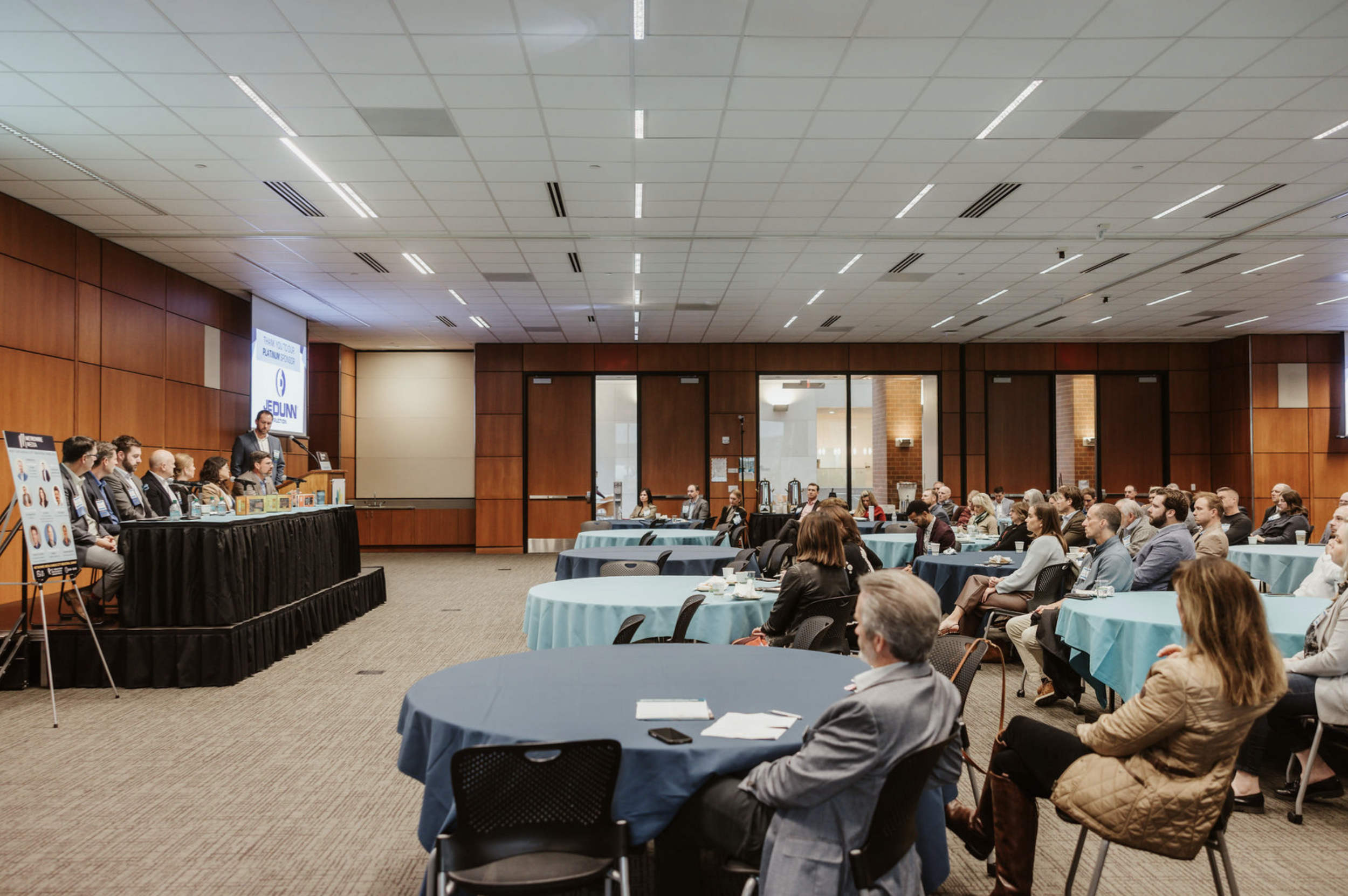
Above: Attendees at MetroWire Media’s 2025 Industrial Summit listen in as the panel discusses the current state of Kansas City’s industrial real estate market. Image | BGSTUDIOS PHOTOGRAPHY + FILM

Speculative vs. Build-to-Suit: Staying Disciplined

Brent Peterson of NAI Heartland provided perspective from the leasing and capital markets side: “KC has been disciplined about what we build, and that’s why we’re still absorbing. Most activity today is build-to-suit, but spec buildings remain vital—especially smaller footprints under 500,000 SF.”

Infrastructure Is Now a Front-End Issue

Krizia Diaz, leading JE Dunn’s industrial manufacturing sector, discussed how “pad-ready” doesn’t always mean infrastructure-ready: “We’re helping clients pivot mid-project to phase development or self-supply utilities like wastewater treatment or power generation. That shifts design, cost, and timeline significantly.”

Flexibility in Design: The New Standard

Kevin Polit of studioNorth Architecture explained how flexible shell buildings support long-term utility: “You’re not just designing for one tenant anymore. You’re building a platform that can support automation, manufacturing, cold storage, or ESG upgrades over decades.”

John Krudwig of Bartlett & West agreed, adding: “We’re designing spec with build-to-suit in mind—high-performing roof structures, flat floors, even modular under-slab systems for future use. It’s more rewarding, more strategic.”

Automation Expectations Are Real—and Rising

Karley Felz, an automation systems expert, shared how tenant demands are shifting: “Automation is no longer optional. With labor tight, tenants want high-speed connectivity, stronger slabs, and wider column spacing. We’re seeing higher employee satisfaction too—robots aren’t replacing people, they’re supporting them.”

Data Centers: Boon or Bottleneck?

The discussion turned to KC’s growing data center market. With Meta and Google investing billions, power availability is now a gating factor. “These aren’t one-and-done builds,” said Gutierrez. “They upgrade every two years. But they also generate secondary demand—construction, manufacturing, automation. It’s an ecosystem.”

Panelists noted the need for better long-term planning around power generation, with Kevin Polit citing innovations like small modular nuclear reactors as viable mid-term solutions. Brent Peterson explained that the “$100 billion” data center numbers are cumulative over decades, reflecting upgrades, infrastructure, and equipment, not just construction.

Above: Guests mingle at the MWM 2025 Industrial Summit at Johnson County Community College before the panel discussion.

Looking Ahead: Where's the Growth?

The panel identified I-35 south of Olathe, Liberty/Northland, and Lee’s Summit as key corridors for future development. “We need more product,” said Gutierrez. “When interest rates drop, we’ll need those buildings ready to go.”

John Krudwig confirmed that multiple spec projects are in design across the region. Peterson added: “Post-2008, speculative development changed our market. If you build it—smartly—they will come.”

The Workforce Pipeline Starts Now

Several panelists praised Kansas City’s workforce development infrastructure, with Ryan Schroeder sharing a personal anecdote about a Rockhurst student exploring trade school: “This generation sees the trades differently—and we should be encouraging that.”

In Closing: Collaboration Remains KC’s Superpower

Angela Dicioccio, MetroWire’s Event Director, wrapped the event: “What makes Kansas City work is the collaboration between developers, designers, builders, and economic partners. We’re already planning for 2026—and with the World Cup coming, Kansas City is about to take the global stage.”


Header image: Panelists discuss what's driving the Industrial real estate market in the Kansas City region at MetroWire Media's 2025 Industrial Summit at the Regnier Center- Johnson County Community College. Image | BGSTUDIOS PHOTOGRAPHY + FILM

Amazon expands Midwest presence with 1.1 million-SF Olathe facility

Amazon has finalized the purchase of a 1.1 million-square-foot warehouse at the northwest corner of 175th Street and Hedge Lane, strengthening the company’s regional logistics network in the Kansas City metropolitan area.

The new facility, announced Oct. 20, 2025, is among the largest industrial properties in Johnson County. Strategically positioned near major highways and freight routes, the site will serve as a key hub for fulfillment and distribution operations, enhancing Amazon’s ability to meet growing consumer demand across the Midwest.

City and county leaders view the project as a major investment that will bring jobs, infrastructure upgrades, and increased visibility to Olathe’s expanding industrial corridor. Economic development officials collaborated with Amazon to identify and secure the site, citing its accessibility and room for continued growth.

While specific details of Amazon’s operational plans have not been disclosed, similar large-scale facilities typically support hundreds of full-time roles, along with seasonal and contract positions. Local officials emphasized that the project aligns with ongoing efforts to attract high-capacity logistics users and diversify the region’s economic base.

The facility’s scale and location underscore Olathe’s emergence as a distribution hub within the Kansas City market, complementing other major developments along the 175th Street corridor. Construction and site improvements are expected to progress in phases before the building becomes fully operational.

Amazon’s investment marks another step in the company’s continued push to expand its national network, positioning large-format fulfillment centers closer to key population centers for faster, more efficient delivery.


Header image 175th Steet Commerce Center in Olathe, Kan. Photo | McClure

Olathe Council approves incentives for Lineage cold storage facility

The Olathe City Council has granted tax incentives to Lineage Inc. for the construction of a new automated cold storage warehouse, a project projected to exceed $300 million in investment and add hundreds of jobs to the region.

The state-of-the-art facility will rise near 175th Street and Lone Elm Road, covering roughly 219,000 SF on a 146-acre site. Once operational, the project is expected to generate around 200 long-term positions, with an average starting salary of about $60,000. The site selection aligns with Olathe’s employment corridor goals, reinforcing the city’s strategy to attract industrial and logistics-focused growth.

City officials approved a $23 million package of tax incentives for the project, which may include a combination of industrial revenue bonds and property tax abatements. The incentives are contingent upon performance benchmarks tied to job creation, investment thresholds, and operational safety standards.

The council’s approval followed months of review and a close 5-2 vote after the city’s Planning Commission initially recommended denial. Olathe staff cited the project’s alignment with future land-use plans and the city’s ability to support the infrastructure needs of a large-scale industrial operation.

The fully automated facility will serve as a regional logistics hub, supporting food producers, distributors, and retailers throughout the Midwest. Construction is expected to begin in 2026 with completion anticipated by 2027.

City leaders have positioned the Lineage development as a significant step toward expanding Olathe’s role in national supply chain operations. They emphasized that the project will contribute to long-term economic stability, create skilled employment opportunities, and enhance the city’s standing as a center for advanced logistics and cold storage innovation.


Header image: A rendering of the proposed 219,000 SF automated cold storage facility coming to Olathe, Kan. Photo | The City of Olathe

Acquisitions by Arch Street and Artemis strengthens Logistics Park KC's Position as a key distribution hub

Arch Street Capital Advisors, headquartered in New York, and Artemis Real Estate Partners, based in Washington, D.C., have made a significant move to expand their industrial real estate portfolios by acquiring four prime properties in Edgerton, Kan. This new acquisition adds 2.4 million SF of Class A industrial space to their holdings, strengthening their presence in key logistics markets.

The properties, developed by NorthPoint Development between 2014 and 2017, are located within the Logistics Park Kansas City (LPKC), a 2,352-acre industrial park that is considered a key hub for distribution and warehouse operations. This master-planned development offers businesses a strategic advantage due to its close proximity to major transportation routes, including Interstates 29 and 435, as well as its accessibility to Kansas City International Airport. These factors make the park an ideal location for logistics and distribution companies looking to optimize their operations and reach broader markets.

The newly acquired portfolio includes four high-quality facilities that are fully leased to well-established tenants, including Amazon, Walmart, and Demdaco. These buildings are strategically situated within the park and vary in size, catering to different operational needs. The properties reflect the increasing demand for modern, high-specification industrial spaces in the Kansas City area, a region that continues to attract top-tier tenants due to its central location and robust infrastructure.

These facilities, located across several prime spots within LPKC, include properties such as a large warehouse space, which serves as a critical hub for distribution, as well as additional spaces that support a variety of logistics functions. The buildings’ size and functionality make them highly desirable, supporting a range of industries from e-commerce to consumer goods, and further cementing the area’s reputation as a logistics powerhouse.

This acquisition is aligned with Arch Street and Artemis’s ongoing strategy to target institutional-quality industrial assets in prime logistics markets. It also underscores the rapid growth and investment in the Kansas City area’s industrial sector, which has seen a surge in development and interest from major corporations in recent years. Logistics Park Kansas City, with its comprehensive infrastructure and advantageous location, continues to draw large-scale companies looking for efficient, high-performance distribution solutions. With this latest investment, Arch Street and Artemis help to further solidify the park’s status as a leading destination for industrial real estate investment, signaling continued growth and opportunity in the region.


Header image An aerial view of Logistics Park Kansas City, a 2,300-acre+ industrial park, located near Interstates 29 and 435. Image courtesy of Hunt Midwest

MARSHALLTOWN breaks ground on $27M distribution center in KCK

MARSHALLTOWN breaks ground on $27M distribution center in KCK

Feature Photo courtesy of MARSHALLTOWN