Gateway Arch National Park

Fire casts new doubt on Gateway South’s redevelopment vision

The ambitious Gateway South redevelopment just south of the Gateway Arch National Park counts among its backers several well-known development and investment firms — and those relationships will now shape how the project pivots in the wake of the devastating warehouse fire.

The master developer of Gateway South is Good Developments Group (GDG), which has assembled roughly 100 contiguous acres of former industrial land along the downtown riverfront. GDG is working in a joint venture with at least two principal investors: Vault Partners — a Houston-based investment firm — and Millstone Company, a Clayton-based real-estate and private-equity firm.

In addition, the marketing and leasing of the project’s industrial and office components have been entrusted to large brokerage firms. Cushman & Wakefield leads outreach for industrial tenants, while CBRE handles Class A office leasing — part of its original commitment to unlock up to 500,000 square feet of office space within the first phase.

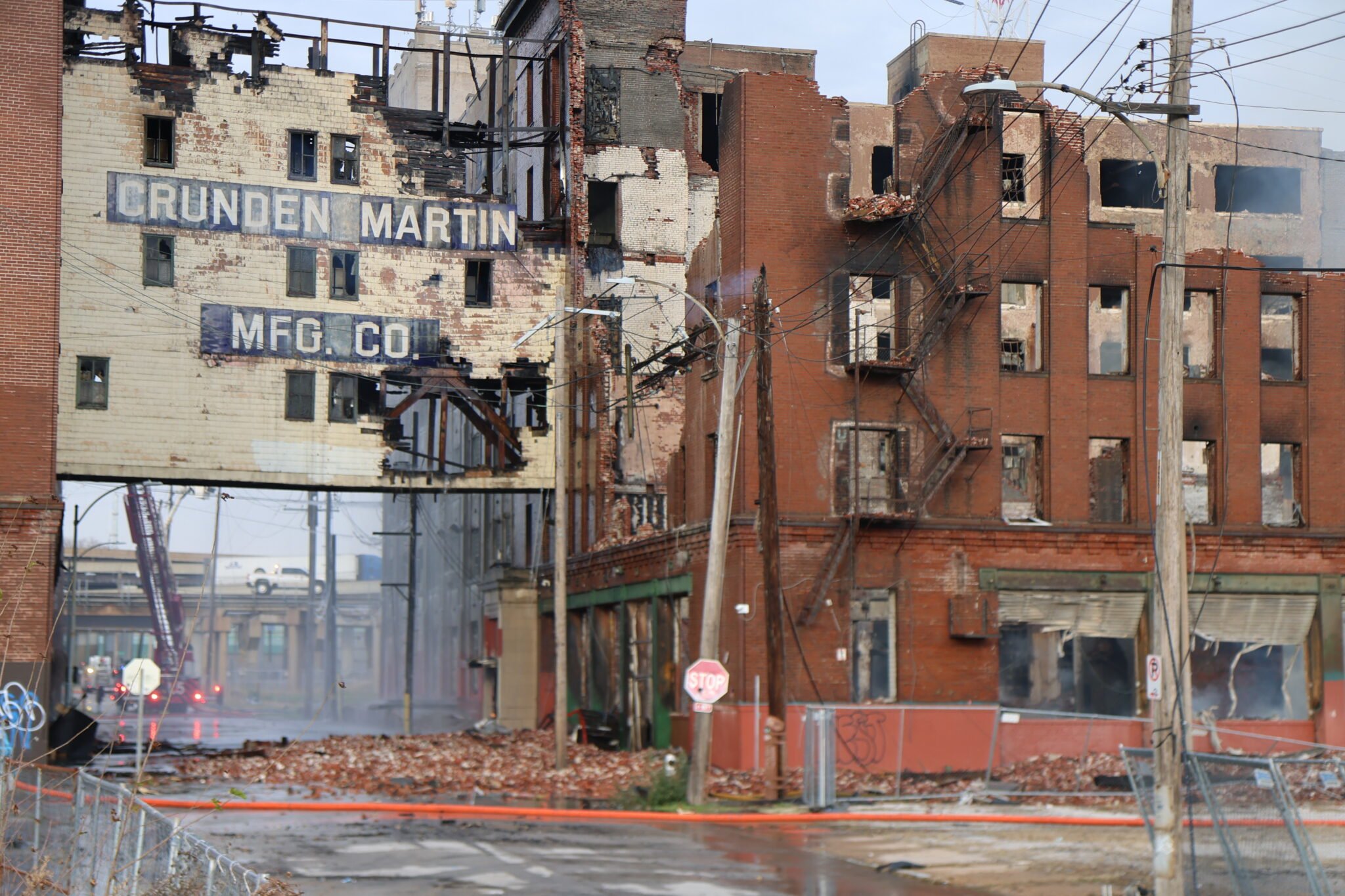
The involvement of these firms will likely influence how Gateway South responds to the fire’s fallout. For example, the financing structure already relies heavily on tax incentives, including historic-preservation tax credits, brownfield credits, and property tax abatements — tools that were integral to the project’s financial viability prior to the fire. With the destruction of part of the historic Crunden‑Martin Manufacturing Company complex — once slated to form the “innovation core” of the district — developers may now need to reassess which tax credits remain applicable, or whether new public subsidies will be required.

Furthermore, the financial and reputational strength of Millstone Company and Vault Partners could prove critical — their backing makes the project more credible to prospective tenants, lenders, and public-funding authorities at a time when confidence may waver. Millstone’s involvement in particular was viewed as a coup for the relatively young Good Developments Group, giving the effort local gravitas and deep experience.

Still, the fire complicates matters. Plans to reuse and repurpose the Crunden-Martin buildings formed the centerpiece of the project’s economic case and identity. With that vision disrupted, the development team may pivot toward building new structures, or redistributing planned uses across other parcels — moves that could require renegotiating financing, zoning, and incentive agreements.

Even so, developers say the broader ambition has not changed. Backup financing — including roughly $155 million in industrial revenue bonds — remains in place for the first phase, and the project’s design and leasing partners remain committed. How quickly Gateway South adapts will depend on whether the existing partners — Good Developments Group, Vault Partners, and Millstone Company — can retool the project’s economics and attract new tenants, even as they weigh the loss of historic fabric against potential for a re-imagined district.


Header image: A massive fire last Friday at the Crunden-Martin Manufacturing Company warehouse building is still under investigation. Photo | NEXTSTL

Demolition of the Millennium Hotel marks the beginning of Cordish’s major redevelopment

Demolition is officially underway at the former Millennium Hotel site in downtown St. Louis, signaling the tangible start of a long-planned transformation of the 28-story complex. The project is being led by The Cordish Companies, which was selected earlier this year by the Gateway Arch Park Foundation.

At an estimated cost of $670 million, Cordish’s proposed redevelopment spans roughly 1.3 million square feet and is set to include a mix of upscale residential units, Class A office space, a food hall, public event space, and an outdoor amphitheater. The plan also calls for dedicated public amenities such as landscaping, pedestrian-friendly walkways, art installations, and possibly even a facility to house the Gateway Arch National Park’s archives.

The Land Clearance for Redevelopment Authority recently gave the green light for Cordish to proceed as developer, accelerating key pre-construction steps. The Gateway Arch Park Foundation, which holds ownership of the site, has coordinated the effort alongside several public and civic partners—including the St. Louis Development Corporation (SLDC), Greater St. Louis, Inc., and planning and design experts such as PGAV.

To carry out the demolition, the Foundation has contracted Spirtas Wrecking Company and Environmental Operations Inc., which completed remediation of hazardous materials before structural teardown began. The work is being done in phases: the central tower was tackled first, followed by the south tower, and ultimately the north tower.

Officials estimate the demolition process will take one to two years to fully clear the site. Once cleared, Cordish is expected to break ground on construction, though the precise timing for full development has not yet been publicly announced.

Beyond the physical redevelopment, the Gateway Arch Park Foundation is also launching a community-driven story-collecting initiative to preserve the memories tied to the former hotel. The effort is aimed at archiving oral histories, photographs, and personal reflections, linking the site’s past to its future.

Taken together, the project—backed by Cordish, the Gateway Arch Park Foundation, SLDC, Greater St. Louis, Inc., and planning partners—promises to reimagine a key downtown location. It aims not only to deliver commercial and residential value, but also to strengthen connections between the Gateway Arch, Ballpark Village, and the heart of downtown St. Louis.


Header image: Spirtas Wrecking along with Environmental Operations Inc. begin demolition of the Millennium Hotel in Downtown St. Louis. Photo | The Gateway Arch Park Foundation

Mansion House Apartments: a mid-century icon repositioned for what’s next

Rising just west of Gateway Arch National Park, the 29-story Mansion House Apartments at 300 N. Fourth St. are a signature piece of St. Louis modernism. Conceived in the mid-1960s by the firm Schwarz & Van Hoefen—whose principals Hari Van Hoefen and Richard Henmi helped define the city’s International Style—the complex introduced glass-and-steel residential living to downtown and anchored a larger “superblock” of mid-century buildings and plazas.

Today, Mansion House is in the midst of a major repositioning. Ownership entity Coral Mountain Owner LLC, which purchased the property in November 2021 for $29.3 million, is advancing a $169 million renovation program. City documents designate Coral Mountain as the redeveloper and note PARIC Corporation as the general contractor, with work spanning apartments, rooftop and pool, building systems, and the public promenade. The plan retains the 415-unit mix while modernizing finishes and amenities to meet current renter expectations.

Public-private alignment underpins the capital stack and execution. The Land Clearance for Redevelopment Authority (LCRA) approved the redeveloper designation, and earlier filings tied to the property referenced local incentives, such as multi-year tax abatements and sales-tax exemptions on construction materials—standard tools for large-scale urban reinvestments. These mechanisms, together with private equity, position the project to absorb significant capital expenditures while improving building performance.

The business plan emphasizes upside over disruption. With a substantial on-site parking supply exceeding 550 spaces and a riverfront location steps from the Arch grounds, the asset can capture demand from downtown employers, civic anchors, and a growing base of destination entertainment. Pro formas in city materials anticipate rent growth after renovation, reflecting the premium urban residents place on contemporary amenities and energy-efficient systems. Importantly, the scope maintains a stable unit count, supporting continuity for the downtown housing pipeline while enhancing quality.

Mansion House’s refresh also preserves a notable chapter of St. Louis design history. By rehabilitating an emblematic International Style tower rather than replacing it, the project aligns with broader downtown goals: retain architectural character, attract new residents, and expand the taxable base through long-term value creation. For investors and partners, the opportunity is clear—deliver a differentiated, amenity-rich product in a landmark location while leveraging established city incentives to de-risk a complex urban redevelopment.


Header image: The 29-story Mansion House Apartments await the next phase of life with a $169 million renovation on the horizon. Image | The Cultural Landscape Foundation - credit: Adam Smith (2018)

St. Louis riverfront set for major redevelopment with $1.2 billion Gateway South project

Cushman & Wakefield has been tapped by St. Louis-based Good Developments Group to market the industrial segment of Gateway South, a sweeping $1.2 billion redevelopment initiative aimed at revitalizing 100 acres along St. Louis' riverfront. The master-planned district, envisioned as a hub for innovation in construction and design, seeks to attract industry leaders through ownership, leasing, and build-to-suit options. The project is slated for a 2025 launch.

Executive Director Tripp Hardin, SIOR, and Director Keith Ziercher, CCIM, from Cushman & Wakefield, will lead outreach efforts for Gateway South, emphasizing the site’s logistics advantages and its unique positioning in the heart of St. Louis. Strategically located just south of the Gateway Arch National Park, this historic site was once a bustling industrial and trade zone, thanks to its proximity to the Mississippi River and central geography. Today, it remains ideal for diverse industrial applications, offering multimodal logistics access via river, road, and rail, plus attractive economic incentives.

The development’s vision is to create a dynamic, integrated district where the city’s existing strength in construction and advanced manufacturing can flourish. St. Louis already boasts a high per-capita concentration of talent in these sectors and the area’s affordability and quality of life position it to attract new talent while retaining its workforce. By clustering industrial, commercial, and residential spaces, Gateway South aims to foster an innovative ecosystem where collaboration across sectors can drive efficiencies and sustainability solutions critical to meeting both housing and environmental needs.

The partnership between Good Developments Group and Cushman & Wakefield combines local insight with a global platform, aiming to draw prominent manufacturers and suppliers in the building industry. This effort not only positions Gateway South as a transformative asset for the downtown riverfront but also as a catalyst for economic growth throughout the St. Louis region.


Header image: A rendering of Good Developments Group’s $1.2 billion project to redevelop approximately 100 acres on the St. Louis riverfront. Image courtesy of Cushman & Wakefield