Wyandotte County faces a crowded incentive landscape as Chiefs stadium talks intensify

Kansas politics and local development buzz have converged in an unprecedented way: the Kansas City Chiefs’ potential move across state lines has turned Wyandotte County and neighboring cities like Olathe into arenas for competing economic incentives. What began as a singular bid for an NFL stadium has mushroomed into a complex web of STAR bond districts, municipal tax pledges, and fierce negotiations involving key decision-makers and business partners statewide.

At the heart of the effort is a massive plan to build a $3 billion domed stadium in Wyandotte County, paired with a new Chiefs headquarters and training facility in Olathe, Johnson County — a project with total development costs approaching $4 billion. The state of Kansas and the Chiefs organization negotiated a public-private partnership that uses STAR (Sales Tax and Revenue) bonds to finance up to 60 percent of the public portion of the work, with the team covering the remaining share. STAR bonds allow public sales tax generated within a designated district to be used to repay bondholders without creating new tax levies on residents.

In Wyandotte County, the Unified Government (UG) of Wyandotte County and Kansas City, Kansas, has held spirited hearings on an ordinance that would establish a STAR bond district stretching more than 200 acres between 118th and 126th streets. Under the proposal, Wyandotte County would pledge future local sales tax, part of county sales tax, and up to 8 percent of transient guest taxes collected in the district toward bond repayment for up to 30 years. A key figure at recent hearings was Todd LaSala, outside development counsel for the UG, who outlined the financial mechanics and conditions for local participation.

Meanwhile, in Olathe, city leaders have moved aggressively on their piece of the Chiefs puzzle. The Olathe City Council voted unanimously to pledge local sales and hotel tax revenue from a 165-acre development site at College Blvd. and Ridgeview Rd. to support STAR bonds for the Chiefs’ headquarters and practice facility. As part of that plan, Olathe would redirect 1 percent of city sales tax and portions of county and hotel taxes generated in the “base revenue area” toward bond repayment. This commitment stretches up to three decades but avoids raising existing tax rates. Mayor John Bacon and council members championed the measure as a catalyst for jobs and long-term economic growth, even amid vocal public debate.

The Chiefs organization, led by Chairman and CEO Clark Hunt, has signaled strong support for both STAR bond districts, making clear that local incentives were a crucial part of the overall agreement with the state. Gov. Laura Kelly and state legislative leaders also played central roles in crafting the incentive framework, including the use of Kansas’s Attracting Professional Sports to Kansas Fund alongside STAR bonds to sweeten the deal without imposing new statewide taxes.

For Wyandotte County and its neighbors, this isn’t just a stadium bid — it’s a test of economic strategy under pressure. With multiple communities pledging future tax revenues and public hearings drawing packed rooms, the Chiefs project has become a catalyst for reconsidering how incentives are used, who pays the price, and how long the benefits must be weighed against competing development needs. 


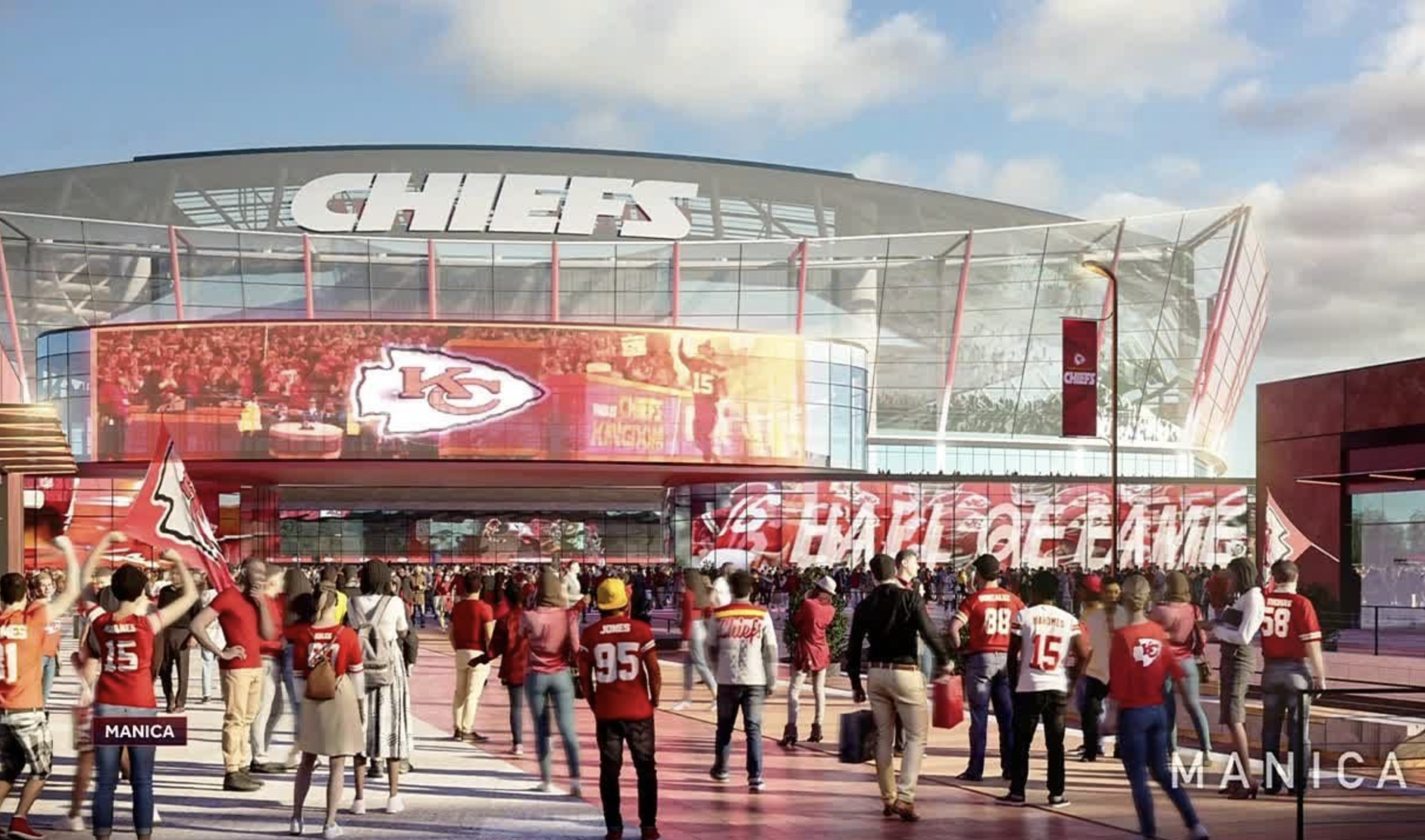
Header image A rendering of a domed Kansas City Chiefs stadium in Wyandotte Co., Kansas. Image | Manica Architecture

Independence, Mo. set to rebuild historic power plant to fuel massive AI data center

Independence, Mo., is positioning itself at the forefront of the artificial intelligence infrastructure boom with plans to reopen and drastically expand a long-dormant power facility to meet the energy needs of a new, billion-dollar AI data center campus. The project, anchored by European cloud computing firm Nebius, will transform the former Blue Valley Power Plant into a powerhouse capable of generating up to nine times more energy than it once did — enough to support cutting-edge AI workloads and bring significant economic activity to the region.

Nebius has announced plans to build its third — and largest — U.S. data center in Independence within the Eastgate Commerce Center, a 400-acre site east of Kansas City. The campus is expected to span roughly 2.5 million SF and include multiple buildings dedicated to high-density AI compute and storage. The full buildout could require at least 800 megawatts (MW) of power, roughly enough to supply hundreds of thousands of homes — a dramatic increase compared to the original plant’s roughly 90 MW capacity.

To supply electricity during the interim, the city is negotiating four separate energy contracts with third-party providers, including NextEra Energy and Evergy. These agreements allow Independence Power and Light to purchase power beginning in mid-2026 and pass costs through to Nebius, keeping local utility rates stable for residents and businesses.

The centerpiece of the energy strategy is the phased redevelopment of the Blue Valley Power Plant. Originally constructed in the late 1950s and shuttered in 2020, the facility will be rebuilt and expanded by Independence Power Partners (IPP) — a joint venture between United Energy Trading, a major North American crude oil and natural gas company, and Exigent Energy, a national energy management firm. This private financing arrangement accelerates construction, with an initial 250 MW phase targeted to come online by 2027 and expansion to over 1,100 MW by 2029.

Local officials emphasize that the project — with construction set to begin later this year — is expected to deliver substantial economic benefits, including construction jobs, longer-term operations roles, and broader investment in regional infrastructure.

As Independence rebuilds its historic power plant to meet the demands of tomorrow’s AI economy, the city is betting that power — and data — can fuel not just machines, but sustained growth for the local community.


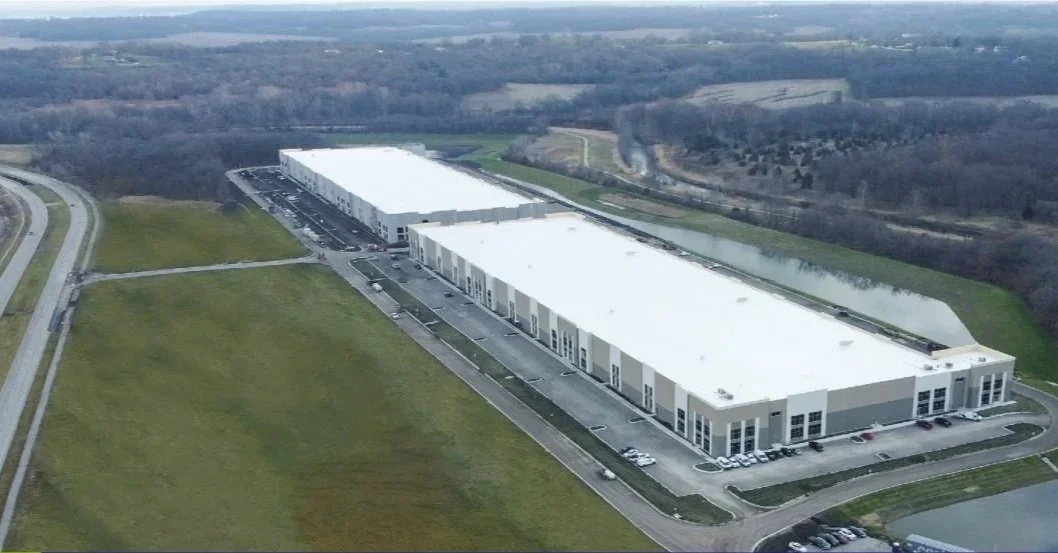
Header image: Eastgate Commerce Center in Independence, Mo. gets a new $1billion AI data center. Photo | Cushman & Wakefield

Former Kansas City Star press building to become $100M AI-Powered tech ampus

Patmos Hosting Inc. is advancing to the next phase of redevelopment at the iconic former Kansas City Star printing press building, located at 1601 McGee Street in downtown Kansas City, Mo., marking a major milestone in the site’s transformation into a futuristic technology hub. The mammoth, 421,112 SF, four-story structure — once a bustling newspaper production facility — is now being reinvented as the Patmos AI Campus, a state-of-the-art data center and multi-use technology destination.

The centerpiece of this redevelopment is a $100 million Commercial Property Assessed Clean Energy (C-PACE) loan arranged by PACE Loan Group through the Show Me PACE program, the largest C-PACE financing secured in Missouri to date. This long-term, private-sector financing will fund energy-efficient infrastructure upgrades — including advanced cooling systems, electrical support, HVAC, plumbing, and other equipment — that are critical to supporting the facility’s powerful computing loads.

Patmos has continued construction since late 2024, quickly building out initial capacity and attracting multiple long-term tenants that have already signed leases for space in the facility. Once fully upgraded in early 2026, the campus will offer 35 megawatts of power tailored for high-density GPU, HPC, and AI infrastructure companies and serve as a flexible hub for modern computing workloads.

Beyond its core role as a data center, the vision for the Star building extends to community-oriented and business-friendly spaces. Patmos plans to convert nearly 150,000 SF of the building into multi-tenant technology offices, co-working space, and event venues, helping foster collaboration, innovation, and downtown activity. There are even plans for features such as suites, a potential Kansas City Police Department outpost, and large open spaces facing Truman Road to engage the surrounding neighborhood.

The redevelopment reflects an adaptive reuse approach, bringing new life to a landmark that had sat largely empty since The Star moved operations out in 2022. By repurposing the structure instead of building anew, the project aims to accelerate deployment timelines, reduce environmental impact, and anchor significant economic growth in the Crossroads district.

Key partners in this transformation include PACE Loan Group and the Show Me PACE program for financing, with Patmos managing the build-out in collaboration with construction and engineering teams (specific vendors and general contractors have not been publicly detailed). As Kansas City continues to grow as a tech and AI hub, the Patmos AI Campus stands out as a landmark example of urban revitalization and next-generation infrastructure investment. 


Header image: The former Kansas City Star printing building at 16th and McGee in Kansas City, Mo. Image | Patmos/LoopNet

Chiefs’ move to Kansas could transform commercial development across the metro

The Kansas City Chiefs’ planned move to the Kansas side of the Kansas City metro area is already reshaping expectations for commercial growth, real estate investment, and long-term economic development. While the relocation would mark the end of the team’s decades-long run in Missouri, it is widely viewed by Kansas officials and developers as a generational opportunity to anchor new construction and private investment around a modern NFL stadium.

The proposed project centers on a new domed stadium in Wyandotte County, a move that would position the region to compete for major events beyond professional football, including concerts, conventions, and national sporting events. Economic development leaders say the stadium itself is only part of the story. The surrounding land is expected to attract a wave of mixed-use development designed to create year-round activity rather than a venue that sits largely idle outside of game days.

Developers are already speculating about new hotels, restaurants, and entertainment concepts aimed at capturing crowds drawn by games and special events. Retail space, office buildings, and residential projects are also likely, following a national trend in which sports venues anchor walkable districts that blend work, housing, and leisure. Similar developments around newer NFL stadiums have shown that teams increasingly serve as catalysts for broader commercial ecosystems rather than standalone attractions.

The Chiefs’ potential relocation is also expected to influence development patterns beyond the stadium site. Areas along major highway corridors in Kansas could see increased interest from employers seeking proximity to a high-profile destination and improved infrastructure. Hospitality and service industries are anticipated to benefit most immediately, while longer-term growth could include corporate offices and regional headquarters drawn by the visibility and prestige associated with the franchise.

Supporters argue the move would solidify the Kansas side of the metro as a hub for sports-driven economic development, while critics raise concerns about public financing and the loss of revenue for Missouri. Even so, real estate professionals note that large-scale stadium projects often generate momentum that extends well beyond initial projections, especially when paired with intentional planning and private-sector participation.

If the relocation proceeds, the Chiefs’ new home could reshape the commercial landscape of the metro area for decades, signaling a shift in how professional sports franchises influence urban growth, land use, and regional competition in the Kansas City area.


Header image: A rendering of a new Kansas City Chiefs stadium that may be built near the Legends in Wyandotte County, Kan. Image | Manica

Royals Stadium debate pits economic promise against community pushback

The Kansas City Royals are weighing three potential locations for a new ballpark as their lease at Kauffman Stadium approaches its end, but a growing wave of local opposition — most loudly voiced in Johnson County — has turned the search into a high-stakes political and economic tug of war.

Team officials have identified North Kansas City, a site just south of downtown Kansas City, and the Aspiria campus area in Overland Park as the primary options under consideration. The Aspiria site, near 119th Street and Nall Avenue, drew public attention after a Royals affiliate purchased the property’s mortgage as part of a broader site-evaluation process.

Supporters of a move point to potential economic benefits: a modern stadium could spur mixed-use development, increase hotel and restaurant business, and expand the region’s entertainment footprint, particularly if paired with residential and office projects that promote walkability and year-round use. Proponents say a thoughtfully designed ballpark can act as a catalyst for urban renewal and new tax revenues without forever burdening taxpayers.

But the proposal at Aspiria has encountered intense resistance from suburban neighbors and municipal leaders worried about traffic, neighborhood character and the loss of existing jobs. T-Mobile, which maintains a major presence at the former Sprint campus, warned it could relocate more than 3,500 employees if a stadium were built on the site, saying the campus cannot accommodate both a corporate workforce and a major-league ballpark. That threat has become a central talking point for opponents who say the immediate economic costs could outweigh long-term gains.

Leawood and other Johnson County communities have hosted town halls, organized petitions and issued formal letters opposing the Overland Park option, arguing residents were left with more questions than answers about traffic mitigation, public financing and the long-term master plan for the area. More than 1,300 signatures have been collected on a petition opposing a stadium at the Aspiria campus, and local elected officials have publicly registered their concern.

North Kansas City and the downtown site offer different trade-offs. North Kansas City supporters emphasize better connectivity to existing transit arteries, shorter commutes for many metro residents and the chance to integrate housing and retail around the ballpark. A downtown-adjacent location promises higher foot traffic and tourism synergies but raises familiar worries about displacement, parking strain, and whether increased development around a stadium will serve longtime residents or primarily outside investors.

State and local deadlines add urgency. Kansas and Missouri lawmakers have moved incentives into place, and advisory deadlines this winter and next year have focused attention on the timetable for a deal — elevating both public pressure and political risk for officials who must decide whether to back taxpayer support for infrastructure and transit improvements.

The Royals insist no final decision has been made and that they are continuing to evaluate options in both states, but the path forward will require negotiating a delicate balance: placating anxious suburbs, retaining major employers, protecting neighborhood character and building a venue robust enough to anchor future development. Whatever site is chosen, the outcome will reverberate beyond baseball — reshaping traffic patterns, employment locations and the economic map of the Kansas City region for decades. 


Header image: A rendering of a new Kansas City Royals stadium proposed just south of downtown Kansas City, Mo. Image | Kansas City Royals