Grocer's Warehouse complex sells to Taing Capital Group

The Grocer’s Warehouse complex, anchored by Hufft Architecture and Fabrication in the historic Roanoke Park neighborhood of Kansas City, Mo., has sold to Taing Capital Group, LLC.

Originally a manufacturing facility built in 1949 by Kansas City grocer Fred Wolferman, the iconic building was redeveloped into creative office and living space in 2015. The 60,000 SF building has seven commercial tenant spaces and studio loft apartments.

Hufft plans to remain in its current space as the GW anchor, along with the other tenants including Studio Lofts, Real Fitness & Conditioning, Pure Workplace Solutions, Roanoke Park Conservancy, MEDiAHEAD and ZancTank Concepts.

“We have realized our master plan for the Grocer’s Warehouse campus and properties. It has been a phenomenal process to see it transform. While our primary roles lie in running Hufft, we were ready for a group to take over the management and all of the responsibilities that come with that. We are very much looking forward to staying a part of the GW campus and Roanoke Park for a long time. The Roanoke Park Conservancy is really to be credited for their efforts in making this location a desired place to work and live. That group holds the original visionaries that believed in this beautiful area of Kansas City,” said Hufft co-founder and principal, Jesse Hufft.

Logan Freeman of Clemons Real Estate and Parker Webb with Third Space Property Group represented the buyer and Pat Murfey of Evergreen Real Estate Services represented the seller in the June 2020 transaction.

"This was a great collaboration between the current ownership group and the new buyers. It was definitely an uphill battle with the pandemic and commercial tenants being a large percentage of the rental income. Securing financing was tricky, but we had a local lender step up who believed in the project as much as we do. Both sides worked together great and are going to continue this vision for the Grocer’s Warehouse and the surrounding Roanoke Park area," Freeman said.

Read previous Grocer’s Warehouse stories by MWM here:

July 2019

Sept 2017

CCIM economist navigates road to recovery

K.C. Conway, chief economist of the CCIM Institute and director of research for Alabama Center for Real Estate, delivered an economic update webinar to commercial real estate professionals last week.

As a whole, Conway believes the economy, which spiraled downward with the COVID-19 lockdowns, is far from recovery, a perspective reinforced by recent comments from Jerome Powell, chair of the Federal Reserve

“If we were recovering and creating 2.5 million jobs a month, do you think the Fed would make the statement that it was not even thinking about making interest rate hikes until 2022? Not even 2021? This tells you how fragile the economy is; how much intervention the Fed is going to have to do,” Conway said.

Conway predicts that there will be a massive oversupply of oil as supply cut production agreements expire at the end of June. 

“I think energy is going to remain very, very volatile. That’s good for the consumer and for transportation, but it’s not a good indicator that things are really recovering from the economy. I don’t think energy is saying we’re there yet either,” Conway said.

The housing market also does not reflect a recovery. With eight percent of mortgages subject to forbearance agreements which won’t expire for six to 12 months, Conway said we’re not going to fully understand the impact of housing until next spring. 

“When you also look at what’s rising in terms of mortgage delinquencies, we’re essentially at 15% of all homeowners delinquent in their mortgages or in forbearance, and that’s record numbers even compared to 2009,” noted Conway.

According to Conway, there are four metrics which are most predictive in determining when we’ve arrived at recovery. The first is the Transportation Security Administration (TSA) daily passenger count, which is currently in the 200,000 to 300,000 range.

“If we don’t see this climb back toward 1.5 million this fall, we are in serious trouble," Conway said. 

The second metric upon which he relies is the number of loans transferred to special servicers. He noted that these loan transfers are reaching record numbers.

The third predictive metric is transaction activity. Conway said that activity currently is locked up because the 500 largest pension and institutional funds are not investing in commercial real estate until they get past their mark to market accounting at the end of June and determine how to reallocate capital. However, Conway is optimistic. 

“Capital is coming back this fall to commercial real estate,” he said.

The fourth and final predictive metric is corporate earnings. He encouraged his audience to follow the earnings of companies that drive their local economies, including those companies that are the major tenants of local retail centers and office buildings.

Conway also predicts major changes to logistics. 

“What we’re going to see is the rest of the world awaken to the fact that it’s a really bad idea to put all of your manufacturing dependence in one place in the world.” 

Consequently, he said some of the manufacturing currently done in China or other parts of Asia will move back to Europe and the United States, but much will go to Mexico, increasing the importance of Kansas City, local intermodal installations and Kansas City rail as trade moves more north and south, rather than from the west coast to the east coast.

Conway noted that casualties of the pandemic will include the failure of one in four businesses and the closure of 40 percent of restaurants nationally. Consequently, a lot of inventory and equipment that was ordered pre-pandemic but not shipped during the shutdown will arrive at businesses that have closed.  

“That’s about 50 million SF of additional warehouse space that we’re going to have to have to store orders that have finally come in. This will provide adaptive reuse opportunities for properties like closed big box retailers and department stores in enclosed malls,” Conway said.

Conway predicts leisure and travel properties will change substantially as well, shifting hotels in the future to be smaller with exterior room entry and contactless features. 

In addition, Conway sees every ratio to which the commercial real estate industry is accustomed, to change.

“Density ratios in office, density ratios in restaurants, expense ratios, occupancy cost ratios . . . parking ratios because we’re going to do more ‘click it and pick up,’ rather than ‘park and drive in,’ which will add a whole new dimension to future site selection,” Conway said. 

“What I think is going to make the difference is what’s called immunity passports,” which currently are being utilized in Europe. 

Immunity passports in the United States will rely upon technology that is already available, although HIPAA laws will need to be amended. 

Conway predicts that within two years, we are going to have mouth swab kits to test for antibodies.

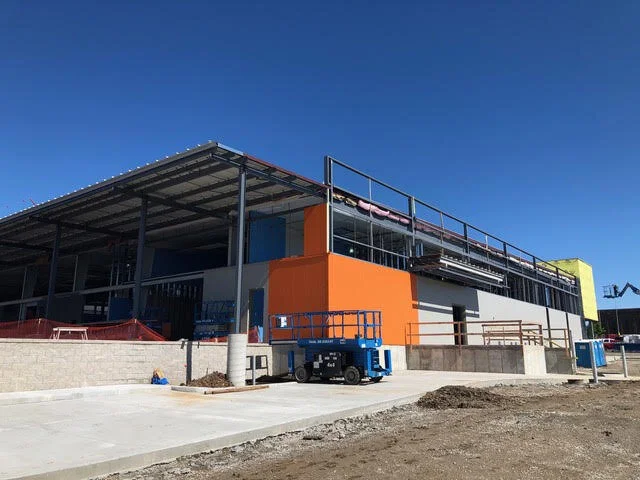
Construction progressing at Wonderscope Children's Museum

Construction progressing at Wonderscope Children's Museum

Photo caption: The eye-catching orange and gray exterior is taking shape on the southeast corner of the 30,000 SF Wonderscope Children's Museum. Photo courtesy of Tracey Mershon, Mershon & McDonald.

Onspring plans new HQ, move to Leawood

Onspring plans new HQ, move to Leawood

Rendering credit: BRR Architecture

Centric partners persevere, celebrate a decade building KC

Centric partners Richard Wetzel and Steve Swanson, two design and construction veterans, are no strangers to persevering through a tough economy. This week is no exception, as they celebrate a decade of success in Kansas City.

In June 2010, the unemployment rate in the United States was 9.4% and the construction industry was experiencing the worst month for spending since the beginning of the downturn in 2008.

The duo recognized a need for a more nimble, agile and flexible company in an industry not known for innovation. Powered by a strong, entrepreneurial spirit, Centric was launched on June 4, 2010.

The start-up, bootstrap nature of the company paved the way for pioneering the use of cloud-computing systems, the development of open-office concepts and the involvement in the arts community.

In the past 10 years Centric has completed 828 projects totaling $618 million, ranging in size from a few hundred dollars to over $35 million. Their body of work includes workplace, retail, multifamily, healthcare, hospitality, industrial, senior living, institutional and - more recently, features custom single-family homes. The company currently employs 158 associates who work remotely on job sites or from its home in the Crossroads Arts District where it has headquartered since its founding.

“We’re proud to have been involved in many important projects integral in sustaining the momentum of development in Kansas City, but perhaps the most important body of work we have been awarded is along the Troost Avenue corridor,” said Wetzel.

“With a history of racism, redlining, and segregation, this area has long been a symbol of division in Kansas City, but is now a hotspot for development. We are excited to be part of this sea of change and look forward to seeing that divide permanently mended.”

Centric is currently involved in over $100 million of work in the corridor from 27th Street to 65th Street, including multifamily, institutional, office and retail developments.

Other notable Centric projects include a nine-story addition to the Ambassador Hotel, the apartments at 3435 Main Street, the luxury apartment building at 1914 Main Street (the first new construction project along the KC Streetcar), and eight Spira Care clinics. Among their most memorable, includes lifting a post-war DC-3, used in the Berlin airlift, onto the roof of the Roasterie Café in Kansas City’s westside.

“While we are going through a truly unprecedented time both in our community and worldwide, we remain optimistic about the future growth and development of our city and look forward to its next decade. Kansas City is our home, and we will continue to strive to make it a cooler place to live, work and play, by building stories from the ground up," Swanson said.